AZPML
  • Projects
    • Use
      • Civic
      • Culture
      • Education
      • Exhibition
      • Infrastructure
      • Landscape
      • Leisure
      • Masterplanning
      • Mixed Use
      • Office
      • Research
      • Residential
      • Retail
      • Sport
      • Transport
    • Size
      • <1.000m2
      • 1.000 – 5.000m2
      • 5.000 – 10.000m2
      • 10.000 – 50.000m2
      • >50.000m2
    • Location
      • Africa
      • Asia
      • Australia
      • Europe
      • North America
      • South America
  • About
    • Profile
    • Principals
    • Awards
    • Publications
  • Contacts

Client: EMT Madrid

Location: Madrid, Spain

Date: 2025

Type: Culture

Area: 10565m2

Budget: €28,322 million


AZPML

Alejandro Zaera-Polo, Maider Llaguno-Munitxa, Ivaylo Nachev


Exhibition Design – OnionLab

Aleix Fernandez, Alejandra Laos, Juan Pablo, Juan Rocha


Engineering & Sustainability – Socotec

Xavier Aguilo


Cost estimation:

Alberto Lopez Diez

Vortex Warehouse

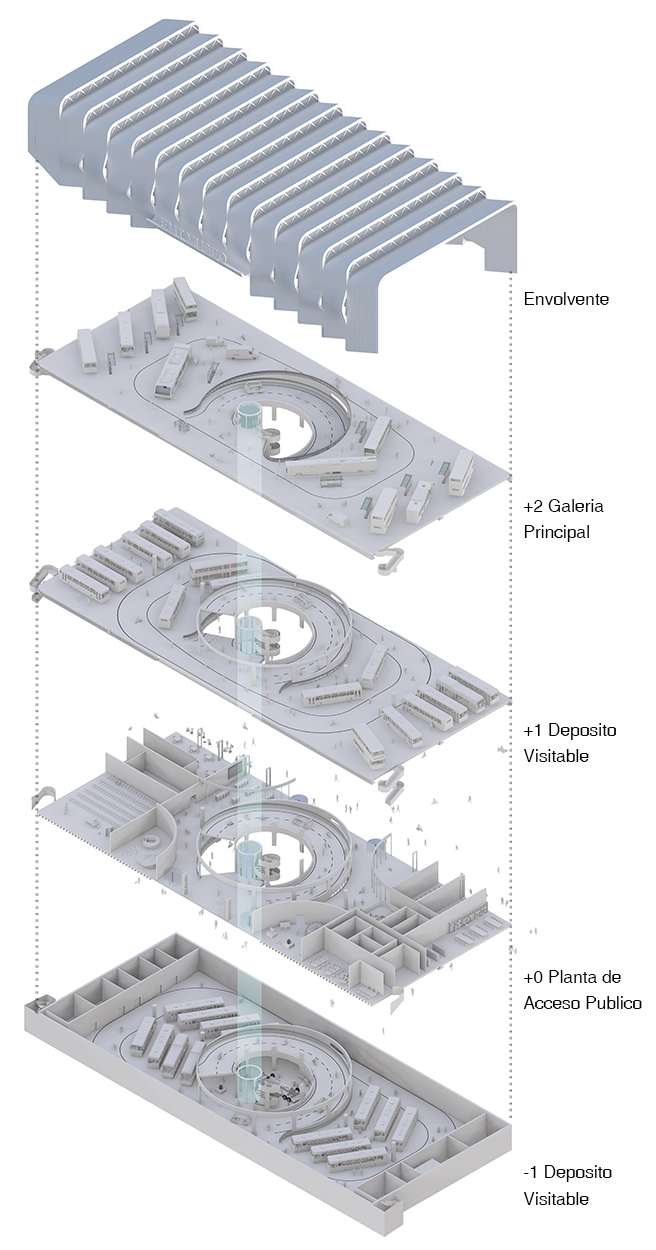
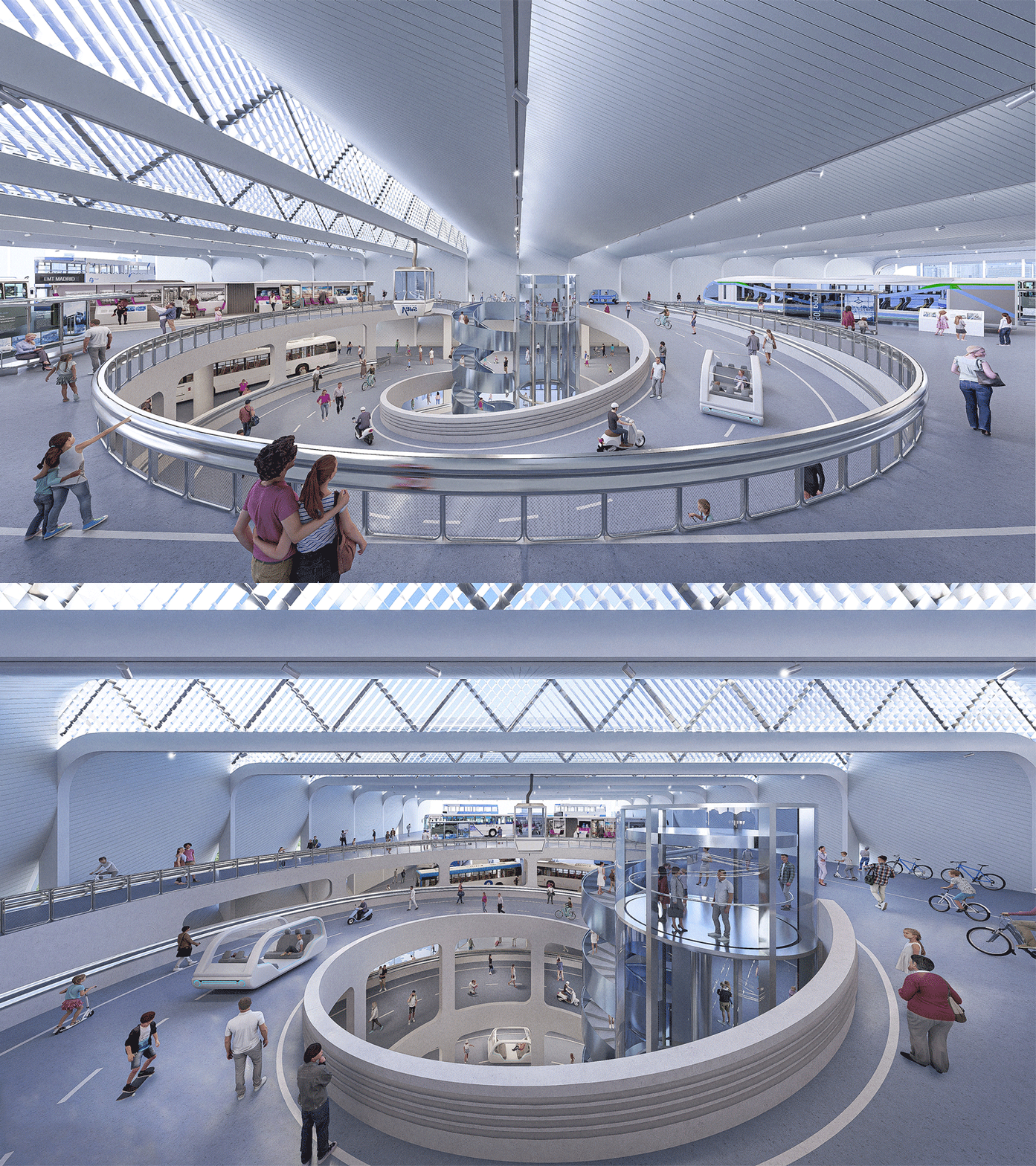
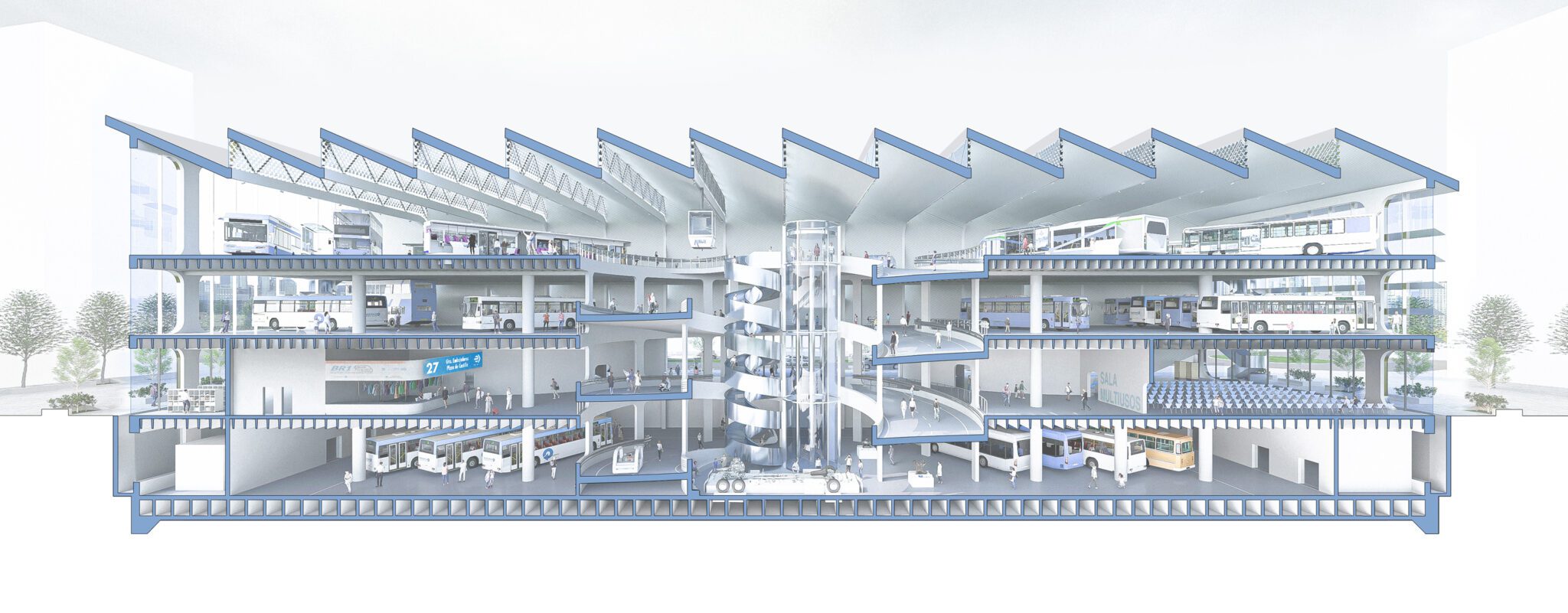
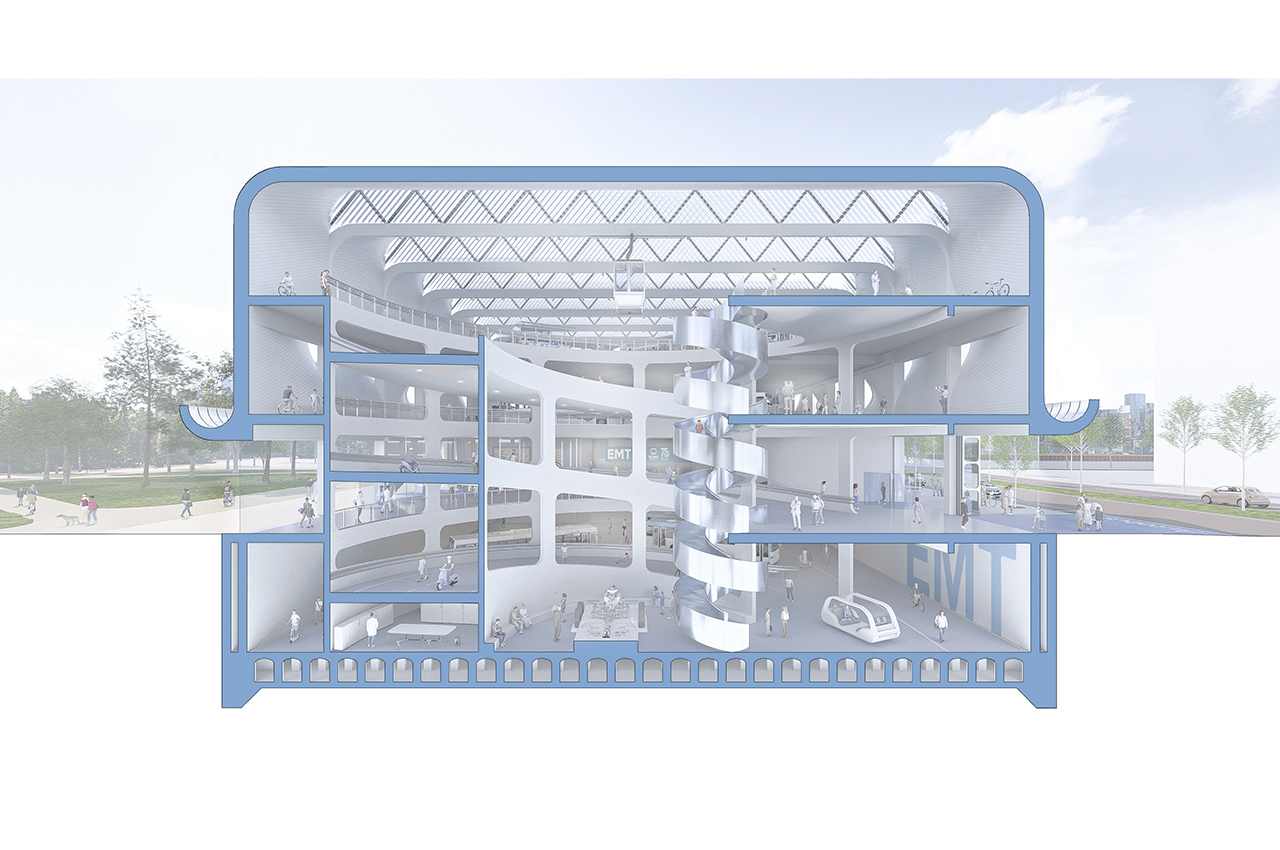
Our project for the EMT Museum aims to meet the requested brief by constructing a physical structure capable of producing optimal conditions for the storage and display of buses, with their very specific qualities of scale and movement. To this end, and given the need to combine the movement of buses and people within the exhibition, storage, and maintenance spaces, we designed the building as a large container with three floors plus a basement, connected by a central ramp around an atrium. The central ramp/atrium creates a physical and visual connection between the warehouse floors, which requires large dimensions to house this unique collection. The atrium/vortex creates programmatic density, creating a space from which the different contents are simultaneously perceived from a human perspective.

The atrium allows for the intensification of the experience within a space sized to contain objects of a very large scale, difficult for the human body to grasp. Maximum spatial flexibility is the other objective of the project, allowing almost all the building’s spaces to be used interchangeably for storage, exhibitions, or bus traffic, anywhere in the building. The building has been designed as a compact volume to simultaneously achieve maximum adjacency between the various elements and optimal environmental performance.

Activation of the Front at Ground Level

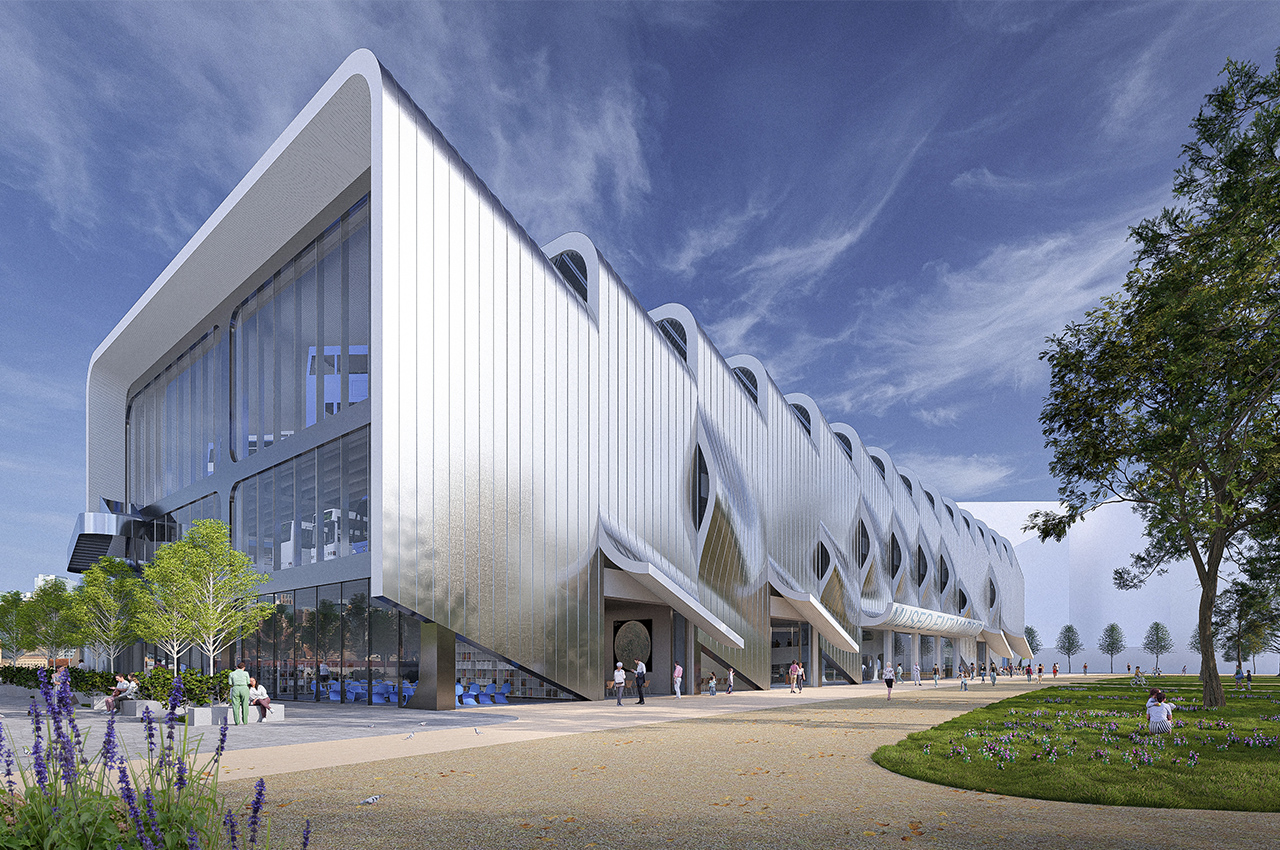
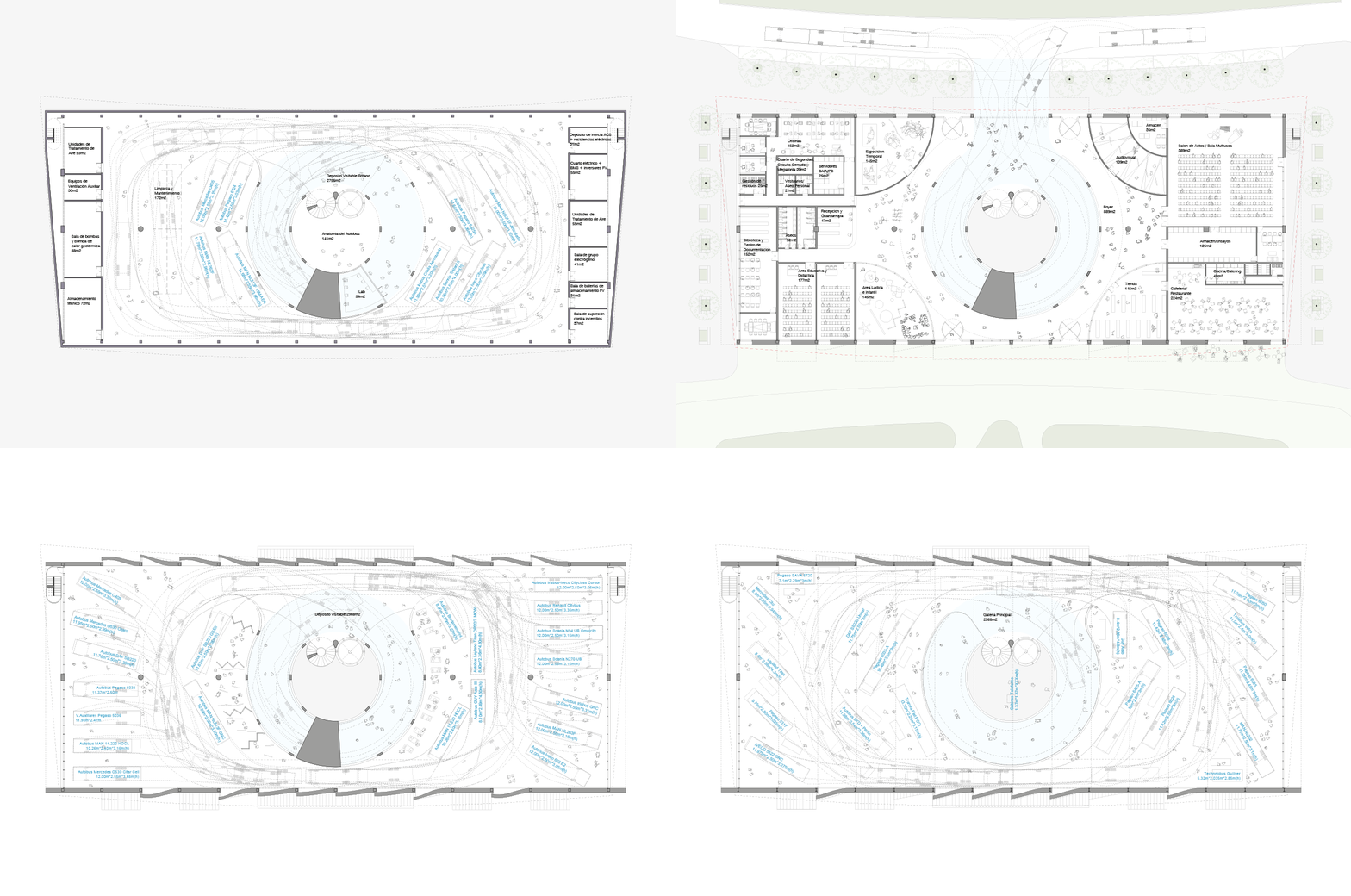
Given the characteristics of the collection and the building’s location within an urban park, an important objective was to locate all of the museum’s complementary activities at ground level, so that the building always has active fronts in relation to the surrounding public spaces. Thus, the cafeteria, the shop, the multifunctional auditorium, the temporary exhibition hall, the library, the classrooms, and the children’s area have been located at ground level, so that they can be accessed directly and independently from the public space at multiple points.

Program Layout

To minimize interior circulation and accessibility, we compacted the building to the maximum extent possible, occupying all available space on the site. It has four floors with a clear height of 5 m, one of which is below ground level, and a buildable area of ​​approximately 10,600 m2.

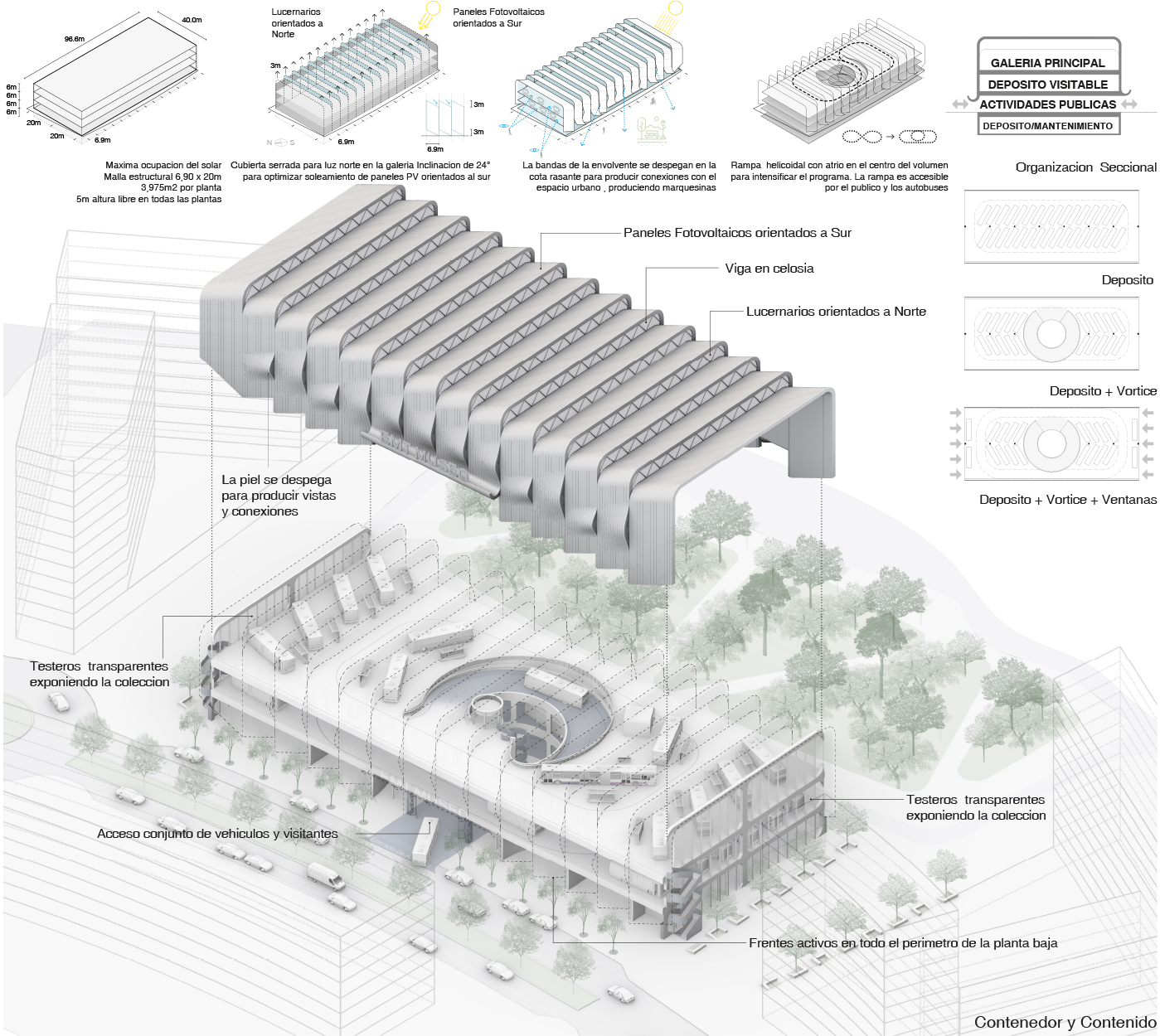
To optimize pedestrian accessibility to the different floors and efficient bus access, the building has been compacted to only three levels above ground level plus a basement. All floors are double-height with a clear space of 5 m, allowing buses to be positioned anywhere in the building, similar to an industrial warehouse. The building is organized around a central atrium that serves as the main distribution and hub of the museum. Around it is a 7.5 m-wide ramp accessible to both buses and visitors, with a minimum slope of 7% on the external radius of the ramp. The atrium measures 15.6 m in diameter and is 24 m high from the basement floor to the roof, making it capable of hosting large events and installations. The atrium also houses the vertical communication core, consisting of an open staircase and a large platform lift.

The museum’s main gallery, located on the second level, receives diffused zenithal light from a jagged roof that simultaneously functions as a solar plant.

The accessible storage area is located between the basement and first floors, both connected to ground level by a spiral ramp. All the complementary spaces are located at ground level: the Children’s Area, the Multipurpose Room/Auditorium, the Temporary Exhibition Hall, the Audiovisual Room, the Information Resource Center/Library, the Meeting and Seminar Rooms, the Restaurant/Cafeteria and the Shop will be located on the ground floor and will open, visually and physically, to the surrounding urban space, being directly accessible from the central atrium/ramp.

Building Character and Envelope

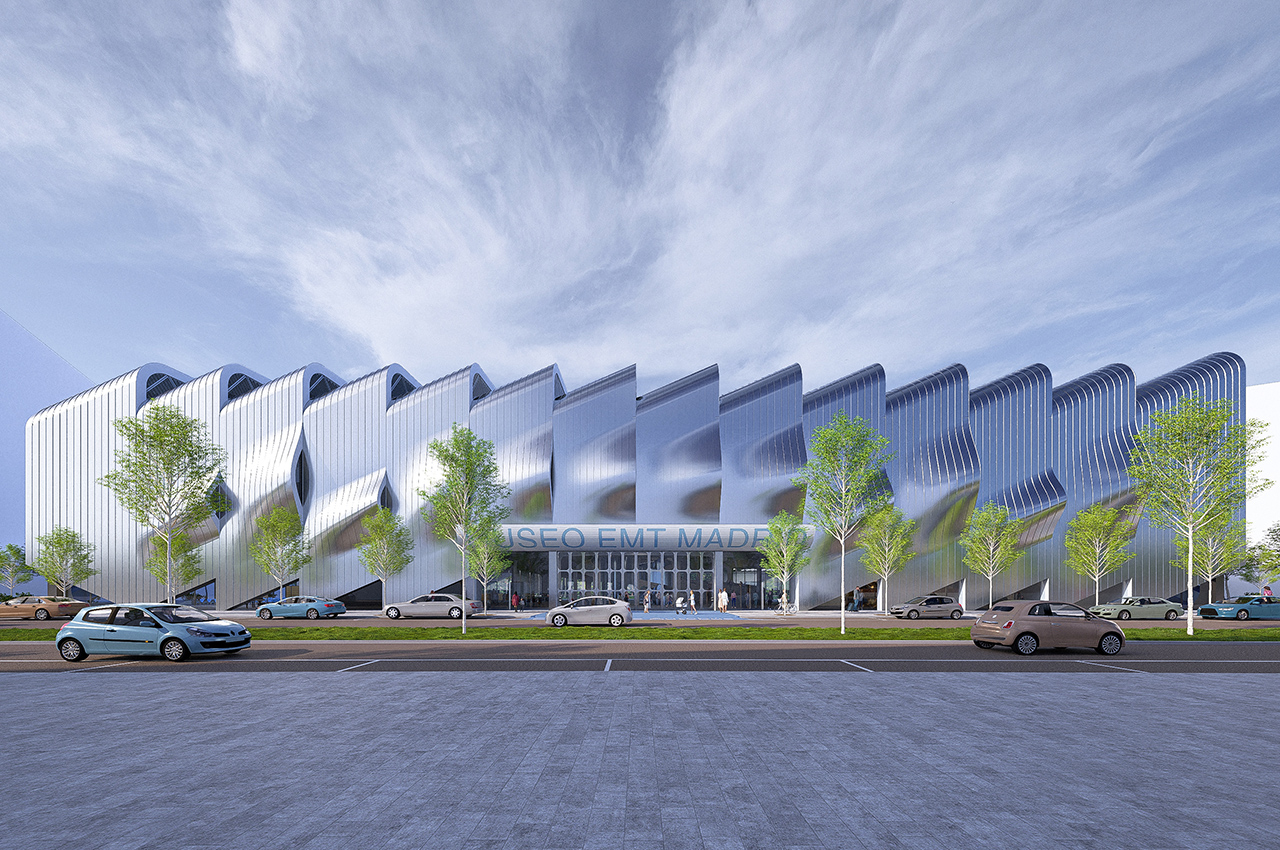
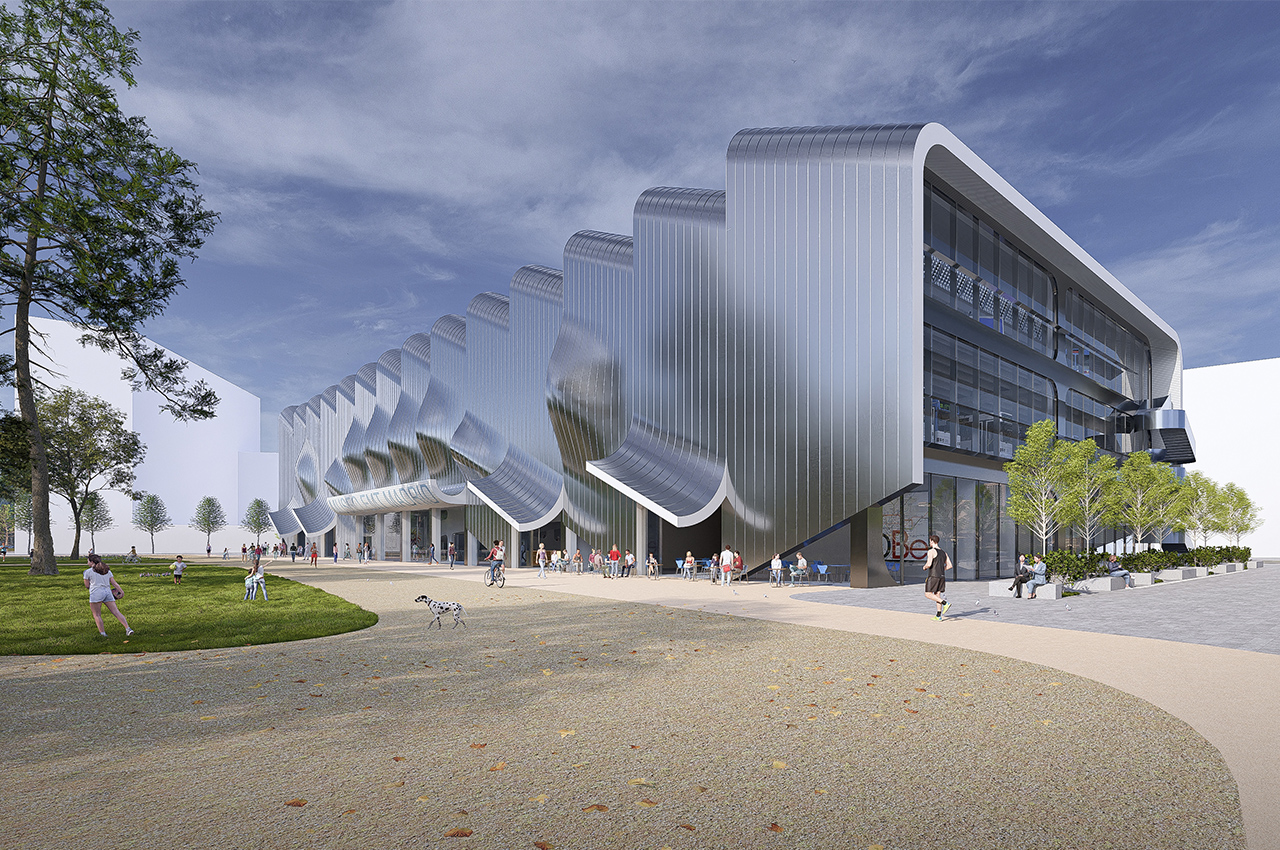
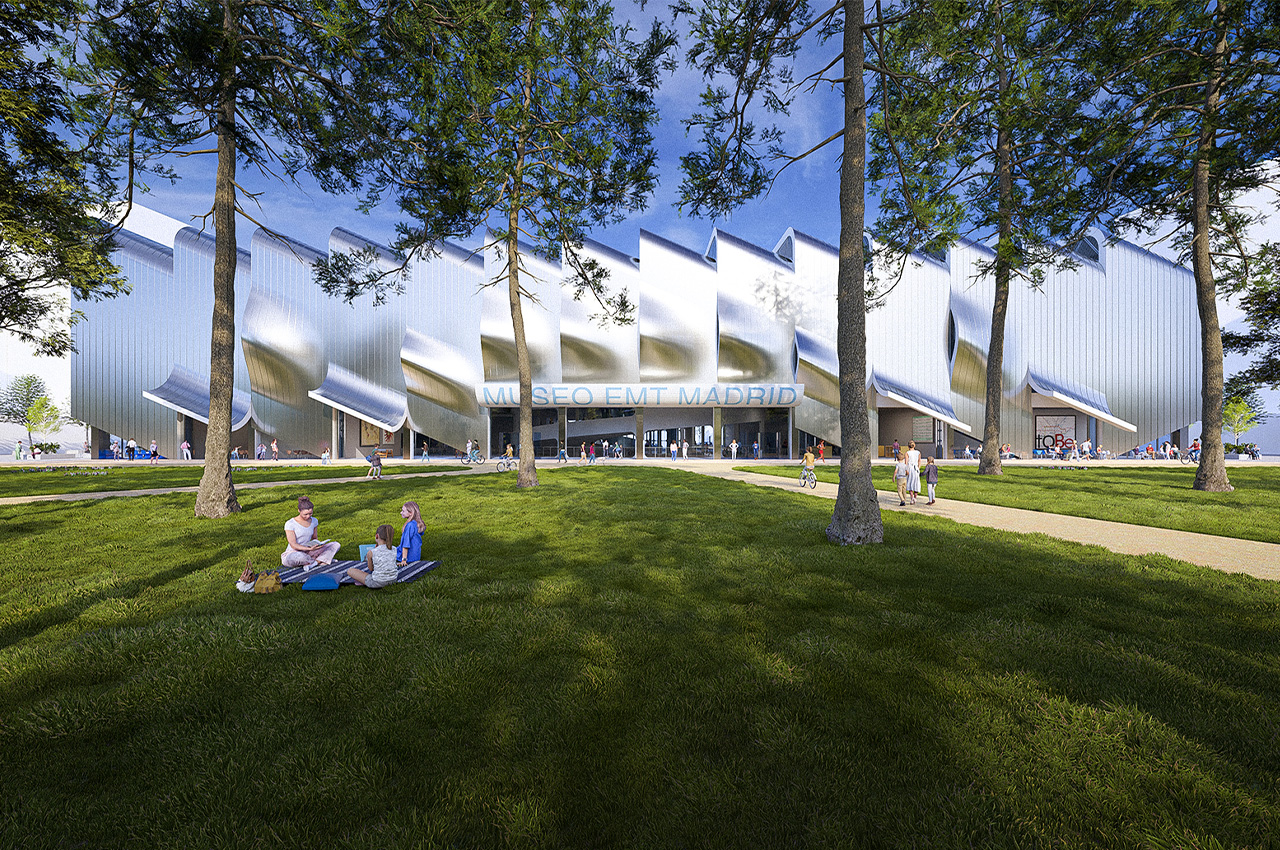
The building is conceived as a large container that seeks to resonate with the type of objects it collects: metal casings with blunt edges and folded surfaces. The volume is configured as a tubular structure closed in the main direction and open at both ends.

The main exhibition floor is located on the second level, lit from above by a sawtooth roof that repeats where it meets the ground, producing the building’s characteristic silhouette as seen from Manzanares Park and the Paseo de los Melancólicos. The northwest and southeast sides are closed with a highly transparent membrane to provide views of the stored buses. The end walls feature a filleted geometry, reminiscent of the carcasses of the vehicles that make up the collection.

The building’s envelope is designed as a lightweight, continuous surface between the vertical walls and the roof. The metal-finished surface is mounted on spacers that leave an air chamber with the interior insulation layer. Inside, the envelope is clad with a surface of white lacquered aluminum sheets, clipped to the inner face of the envelope, which forms the interior finish of the exhibition and storage rooms.

Environmental Conditioning and Energy

The building is designed to optimize environmental performance through a series of active and passive systems:

Passive Systems

1. Compactness to reduce heat gains and losses.

2.Optimization of the building’s orientation (sawtooth roof facing north).

3.Opaque enclosures greater than 70%, limiting heat exchange.

4.Global transmittance values ​​Uvalue < 0.45 W/m² K (well below the CTE).

5.Abundant natural light and ventilation using the atrium to create thermal buoyancy.

6.Thermal mass construction using low-carbon reinforced concrete.

7.Rainwater harvesting.

8.Sanitary chamber in the basement to temper the outside air with the inertia of the ground, in summer and winter.

Active Systems:

Sustainability and Energy Savings

We propose using geothermal energy, powered by photovoltaics, to cover most of the heating, cooling, and DHW needs. An electric air-to-water heat pump supplies the thermal deficit, eliminating the need for a boiler. A resistor-based electrical backup system supports DHW peaks. The system optimizes space and complies with regulations, with low operating costs.

1.Use of the roof as a base for installing photovoltaic panels.

2.Thermal regulation via underfloor heating, supported by air conditioning during peak demand.

3.Heat recovery through enthalpy exchangers.

4.All artificial lighting will be specified with LED luminaires, automatically regulated by occupancy and luminance sensors, and ambient light specifications.
AZPML
LEGAL COPYRIGHT@ AZPML. all copy rights reserved